samedi 8 décembre 2018

AUD/USD, AUD/JPY and EUR/AUD Trend Lines Broken. Reversals Extend


Talking Points – AUD/USD, AUD/JPY, EUR/AUD, RSI Divergence

  • As anticipated, AUD/USD and AUD/JPY turned lower after negative RSI divergences
  • Meanwhile, EUR/AUD had its best week since January after positive RSI divergence
  • These currencies may extend their performance as the Australian Dollar takes a hit

Have a question about what’s in store for Australian Dollar next week? Join a Trading Q&A Webinarto ask it live!

AUD/USD Technical Outlook: Bearish

Last week, we noted multiple RSI divergence reversal signals in AUD/USD, AUD/JPY and EUR/AUD. The significance of divergence is that it shows fading momentum. These provided early warning signals that the Australian Dollar might have been on the verge of depreciating against most of its major peers. That was indeed the case for all three mentioned above.

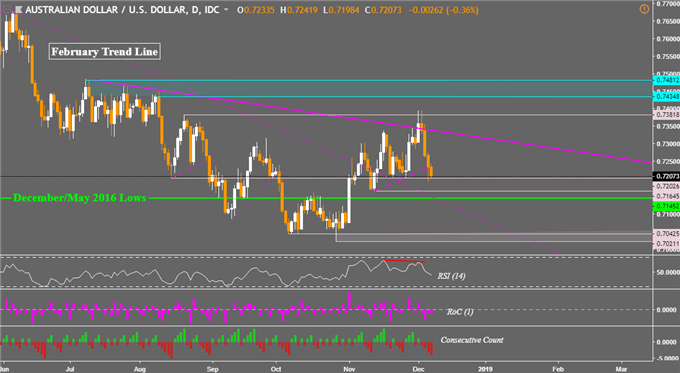
Starting with AUD/USD, the pair turned lower after failing to push above the descending resistance line from July. Here, negative RSI divergence preceded a turn lower as Aussie Dollar headed for its lowest close since mid-November. Prices are now sitting right on horizontal support at 0.72026 which begins with the August 15th low. We did have a descent through a near-term rising support line from November 13th and more declines could be in store ahead. A push through 0.71452 exposes the current 2018 lows.

AUD/USD Daily Chart

AUD/USD, AUD/JPY and EUR/AUD Trend Lines Broken. Reversals Extend

AUD/JPY Technical Outlook:Bearish

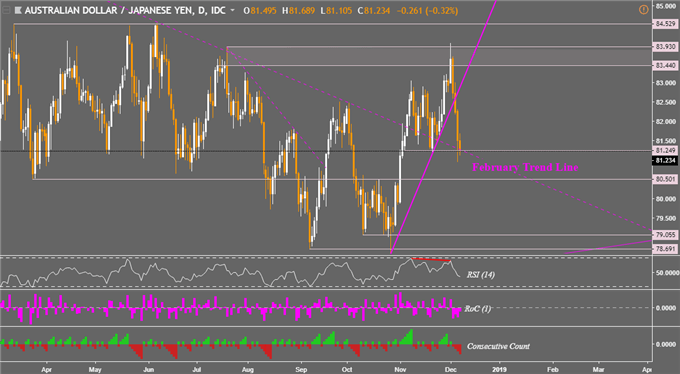
Negative RSI divergence was also present in AUD/JPY last week, since then the pair fell about 3.35%. In its descent, AUD/JPY fell through a rising support line from October which is a bearish signal. But, prices have paused their descent at the February trend line on the chart below. This is also combined with horizontal support at 81.24. Still, AUD/JPY was heading for its lowest close since early November and more losses may be in the cards ahead. Near-term support is at 80.50.

AUD/JPY Daily Chart

AUD/USD, AUD/JPY and EUR/AUD Trend Lines Broken. Reversals Extend

EUR/AUD Technical Outlook:Bullish

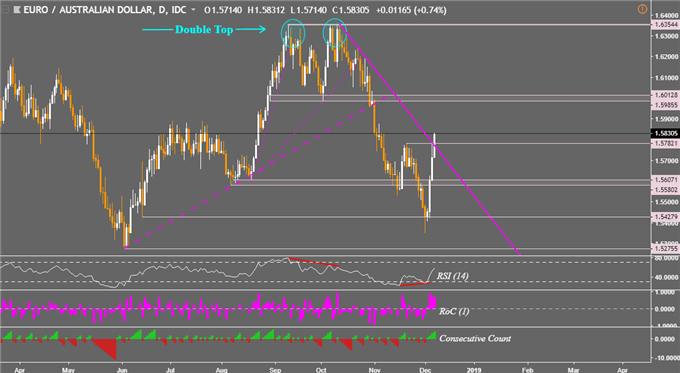
Meanwhile, last week EUR/AUD was overshadowed by positive RSI divergence and that ended up preceding its best weekly performance (about 2.25%) since the last week of January this year. That also brought with it a push above a descending trend line from October. With confirmation of a turn higher, EUR/AUD could be on the verge of reversing its dominant downtrend which was initiated by a double top reversal candlestick pattern. From here, near-term resistance is a range between 1.5985 and 1.6012.

For updates on my coverage of the Australian Dollar, you may follow me on twitter @ddubrovsky for real-time news on major moves in Aussie crosses.

EUR/AUD Daily Chart

AUD/USD, AUD/JPY and EUR/AUD Trend Lines Broken. Reversals Extend

** Charts created in TradingView

— Written by Daniel Dubrovsky, Junior Currency Analyst for DailyFX.com

To contact Daniel, use the comments section below or @ddubrovskyFX on Twitter

Other Weekly Technical Forecast:


Source link


https://ift.tt/2Psv9d0

Price Breakout Approaching Initial Targets


Gold Technical Outlook: Price Breakout Approaching Initial Targets

A breach above the November range takes gold prices near five-month highs. Here are the targets & invalidation levels that matter on the XAU/USD charts next week.

A breach above the November range highs has taken gold prices to levels not seen since mid-July and keeps the focus higher heading into next week. These are the updated targets and invalidation levels that matter on the XAU/USD charts.

New to Gold Trading? Get started with this Free How to Trade Gold -Beginners Guide

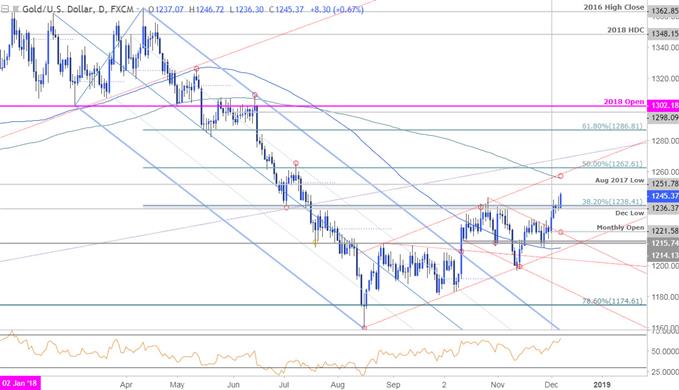
Gold Daily Price Chart (XAU/USD)

Daily Chart of Gold

Technical Outlook: In our last Gold Technical Outlook we noted that a breakout was imminent as price was testing the October trendline. Out ‘bottom line’ cited that “The monthly opening-range remains intact heading into the November close. For now, look for a break of this week’s range for guidance with our broader focus higher while within this ascending pitchfork formation. From a trading standpoint, I continue to favor fading weakness while above 1210.”

Gold rallied through critical resistance early in the week with the advance taking out the November range highs on the way. Daily resistance targets are eyed at the August 2017 low at 1252 backed by the 200-day moving average and the 50% retracement of the yearly range at 1262. Broader bullish invalidation now raised to 1214.

Why does the average trader lose? Avoid these Mistakes in your trading

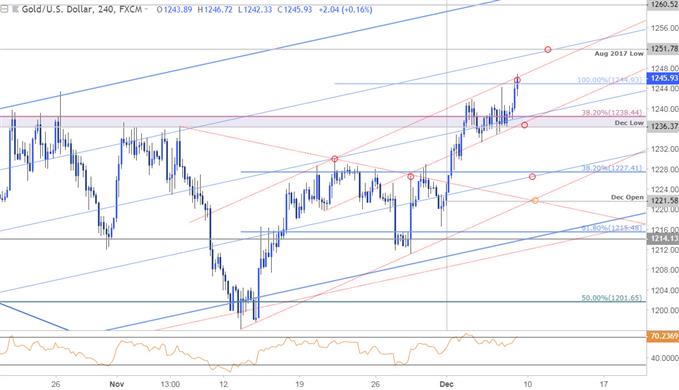
Gold 240min Price Chart (XAU/USD)

4 hour chart of gold

Notes:A closer look at price action sees the advance off the November lows holding within the confines of this slope series (red) and suggests the immediate advance may be vulnerable here heading in to the close of the week. Interim support rests at 1236 – a break there would suggest a larger pullback towards the lower parallels at 1227 and the monthly open at 1221– the near-term focus remains higher while above this level with a topside breach targeting subsequent resistance objectives at 1252, 1260 and 1262.

Learn how to Trade with Confidence in our Free Trading Guide

Bottom line: We’ll favor fading weakness near-term while above the monthly open targeting the upper parallels. From a trading standpoint, a good place to reduce long-exposure / raise protective stops; IF we get a pullback, look for more favorable entries towards slope support next week.

For a complete breakdown of Michael’s trading strategy, review his Foundations of Technical Analysis series on Building a Trading Strategy

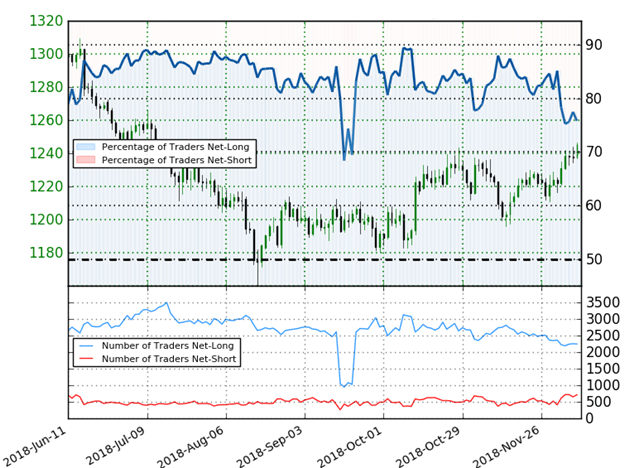
Gold Trader Sentiment

Gold Technical Outlook: Price Breakout Approaching Initial Targets

  • A summary of IG Client Sentiment shows traders are net-long Gold – the ratio stands at +3.14 (75.8% of traders are long) – bearishreading
  • Long positions are4.4% lower than yesterday and 6.4% lower from last week
  • Short positions are 3.6% higher than yesterday and 35.0% higher from last week
  • We typically take a contrarian view to crowd sentiment, and the fact traders are net-long suggests Gold prices may continue to fall. Yet traders are less net-long than yesterday & compared with last week and the recent changes in sentiment warn that the current Gold price trend may soon reverse higher despite the fact traders remain net-long.

– Written by Michael Boutros, Currency Strategist with DailyFX

Follow Mchael on Twitter @MBForex or contact him at mboutros@dailyfx.com

Other Weekly Technical Forecast:

Australian Dollar Forecast – AUD/USD, AUD/JPY and EUR/AUD Trend Lines Broken

British Pound Forecast – Sterling Remains Weak

US Dollar Forecast – Dollar Wind Up Threatens to Resolve with a Break Before 2018 Ends

Equity Forecast – Technical Forecast for the S&P 500, Dow Jones, DAX 30 & FTSE


Source link


https://ift.tt/2QnR1fd

Canadian Dollar’s Shifting Sentiment May Boost Short Term Prospects


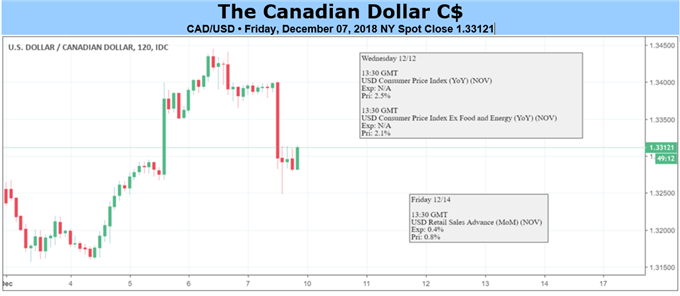
USDCAD Chart

Fundamental Forecast for CAD: Bullish

Talking Points:

  • Expectations for future Bank of Canada interest rate hikes drop
  • OPEC agreement to cut oil production to support the Loonie
  • Event risk to the US Dollar may benefit its Canadian Dollar counterpart

The Canadian Dollar depreciated slightly against its US Dollar counterpart from the 1.3250 level to 1.3300 USD/CAD over the last week of trading. This occurred against a volatile backdrop due to the anticipated policy interest rate decision from the Bank of Canada (BOC), releases of key economic data and speculation over OPEC leaders gathering to agree on curbing oil output.

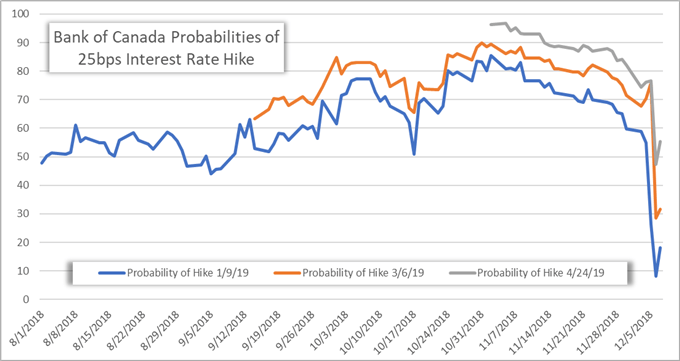
As widely expected, the BOC decided to maintain their overnight policy rate target at 1.75 percent. In its press release immediately following the decision, Canada’s central bank struck a cautious tone over recent economic developments at home and globally. Key concerns cited cratering oil prices, muted business investment and slowing growth across major developed countries. Consequently, markets interpreted the comments as dovish and significantly reduced their expectations for future rate hikes. However, the steep drop in expectations could be an exaggerated knee-jerk reaction.

BOC Meeting Hike Probabilities

The implied probability of future rate hikes declined for most of November paralleling oil’s steep selloff over the period due to a worsening supply glut as fears of a deteriorating global economy mount. BOC noted that the country’s energy industry “will likely be materially weaker than expected.” In turn, this may evolve into a major headwind for the Canadian economy as well as the Canadian Dollar seeing that oil production accounts for $170 billion out of the country’s $1.8 trillion GDP – just shy of 10 percent of total economic output. While the BOC stated that the Canadian economy expanded in line with projections for the third quarter, this could change over the final months of the year as economic data is suggesting positive momentum is fading.

On a more positive note, business investment should pick up with the recently signed US-Mexico-Canada (USMCA) agreement providing more clarity on trade between the countries. Also, employment numbers reported at the end of the week surprised to the upside. The Canadian unemployment rate dropped to 5.6 percent from 5.8 percent and the net change in employment crushed forecasts by adding over 94,000 jobs compared to the expected 10,000. Another development that could support a beaten down Loonie is the recent agreement by OPEC and its partners to cut oil production by 1.2 million barrels per day. Crude oil leapt nearly 6 percent on the news which also sent the Canadian Dollar higher.

The data dependent BOC will closely examine housing stats reported next week as it looks for signs of a sustained rebound across the sector. As for its American counterpart, the US market could come under pressure from highly anticipated data points that pose material downside event risk to the Greenback. With the US Dollar already starting to lose some of its luster due to weaker than expected economic developments and seemingly dovish remarks from the Federal Reserve, the USDCAD could see some downside in the short term due to the recent shift in sentiment.

–Written by Rich Dvorak, Junior Analyst for DailyFX.com

–Follow on Twitter @RichDvorakFX

Other Weekly Fundamental Forecast:

Japanese Yen Forecast – USD/JPY to Track October Range as Attention Turns to U.S. CPI

Oil Forecast – OPEC And Friends Production Cut Exceeds Expectations, Crude Rallies


Source link


https://ift.tt/2RFE3pD

Sigelbaum joins TR to lead FXall


Jill Sigelbaum replaces John Cooley, who left Thomson Reuters in November


Source link


https://ift.tt/2QjTKpL

Huobi Opens First Russian Office in Partnership with State Bank’s Digital Tech Center


Singapore-based cryptocurrency exchange Huobi has officially launched its first branch in Russia on Thursday, Dec. 6, according to a press release shared with Cointelegraph today.

The Moscow-based exchange, dubbed Huobi Russia, is established in partnership with the state-owned Russian Development Bank’s (VEB) Digital Transformation Center and supported by Huobi’s regional exchange partnership program, Huobi Cloud.

The Center of Digital Transformation was created by VEB to promote blockchain and other crypto-related technologies, as its website states.

Back in September of this year, Huobi first joined Russia’s VEB Innovation Fund and became a resident of the Digital Transformation Center to share experience on crypto regulation, with the fund’s CEO claiming that Huobi’s expertise will assist in building a “legal basis that could compete with current promising jurisdictions.”

Speaking at a private event on Thursday, Huobi senior business director David Chen claimed that the launch of Huobi Russia will help to promote the company’s “leading technology and trading expertise to Russian users,” including such skills as “unmatched safety, stability, and user experience.”

Huobi Russia CEO Andrei Grachev also noted the increasing volumes of crypto trading in Russia, claiming that the volumes have “recently exceeded US $20 million in a single day,” regardless of the current bear market.

Russia’s VEB Innovation Fund, created in 2011, is reportedly the “first” Russian specialized center for support and development of disruptive technologies in the fields of management and the functioning of enterprises and government corporations, according to the center’s website.

The innovation center is exploring and implementing various blockchain projects, and houses more than 20 branches of major blockchain and tech companies such as the Ethereum Foundation, Bitcoin (BTC) tech company Bitfury, PricewaterhouseCoopers (PwC), and others.

Vladimir Demin, chairman of VEB’s Innovation Fund, claimed that Russia is “actively promoting the blockchain market,” with VEB willing to play an “important role as a leader in blockchain research and legislation,” as reported in the press release.

Founded in 1922, VEB bank, or “the state corporation Bank for Development and Foreign Economic Affairs,” is the first international bank of the Soviet Union, originally named Roskombank. The bank is responsible for developing the Russian economy, as well as managing Russia’s state debts and pension funds.

Other Russian banks have also shown an interest in blockchain technology.

Recently, major Russian state-backed bank Sberbank conducted an over-the-counter (OTC) monetary repurchase agreement based on blockchain technology. And earlier in November, the Russian branch of Raiffeisen Bank International teamed up with local state oil giant Gazprom Neft to issue a blockchain-enabled bank guarantee.


Source link


https://ift.tt/2G4mmyQ

Forex Tips For Newbies To Keep A Strong Account – SDEFX™


Learn Forex today The So Darn Easy Way™. So Darn Easy Forex strategies are easy to understand and taught in layman’s terms. Get started with your Forex …

source


https://ift.tt/2RLe3sP

Technical Forecast for the S&P 500, Dow Jones, DAX 30 & FTSE


What’s inside:

  • S&P 500 and Dow look to maintain above support
  • DAX 30 closed week below major long-term support
  • FTSE broke March support, now resistance

Looking for forecasts, trade ideas, and educational content? Whether you just got started or have been trading for a while we’ve got you covered on the DailyFX Trading Guides page.

S&P 500 and Dow look to maintain above support

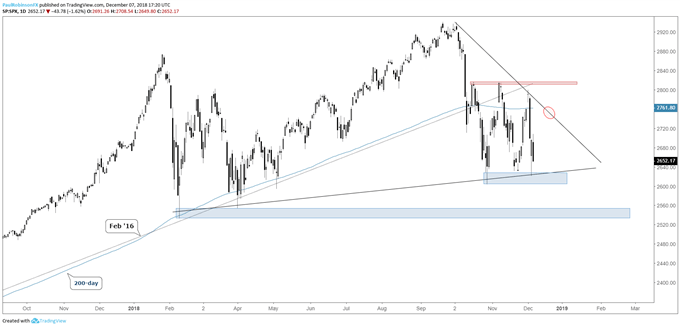
Thursday’s sharp drop and reverse in the S&P 500 has support validated down around the lows from October and November along with the trend-line from early this year. Looking for the market to stabilize a bit, but remain volatile, just perhaps not as volatile as recently. A rebound isn’t likely to last long, however, as general tone and resistance should cap any move higher. For the trend lower to really take hold it will require a break of 2603. It’s a market for the very short-term minded trader as swings in price are quick to wipe out profits.

S&P 500 Daily Chart (Remains supported for now)

Daily chart of S&P 500

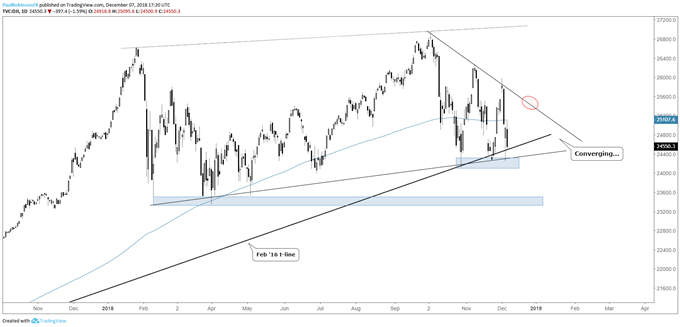
The Dow Jones still refuses to close below the February 2016 trend-line that the S&P 500 has long left behind already. The Thursday reversal took shape from just below this important long-term threshold around the lows from Oct/Nov and the trend-line from the low in February. On the top-side lies a trend-line running down from the record high which capped the gap on Monday. The convergence of bottom and top-side lines could start to dampen volatility, but lead to a potentially explosive opportunity down the road. For now, it’s a vol traders market, back-and-forth.

See the IG Client Sentiment page to view how traders are reacting to the bout of stock market volatility.

Dow Jones Daily Chart (Reversed of confluent support)

Daily chart of DOW

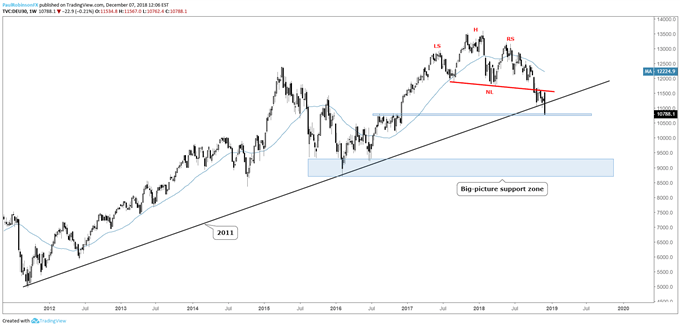
DAX 30 closed week below major long-term support

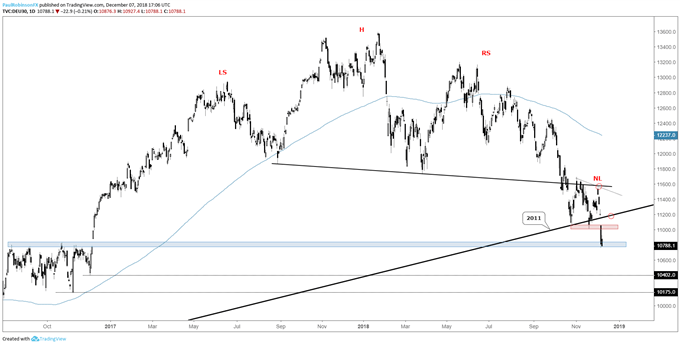
Last week’s tag of the neckline of the long-term head-and-shoulders pattern and subsequent breaking of the 2011 trend-line on a weekly closing basis as the big-picture outlook firmly bearish. While minor support from 2016 may keep the DAX buoyed near-term, a move higher from here is viewed as a seller’s bounce. The area immediately surrounding 11k is first up as resistance, followed by a retest of the broken 2011 trend-line. On a break below last week’s low of 10762 (2016 support), the next levels of are 10402 and then 10175.

DAX Daily Chart (Short-term support)

Daily chart of DAX

DAX Weekly Chart (Weekly close below 2011 trend-line)

Weekly chart of the DAX

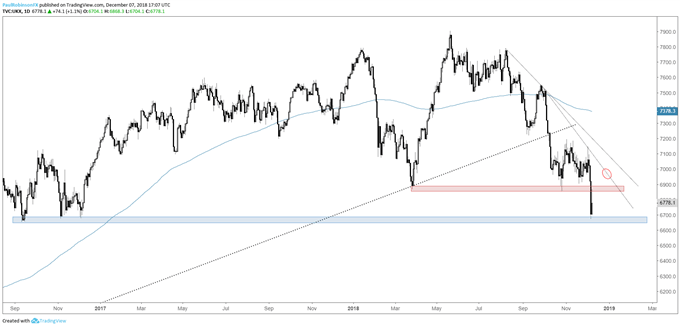
FTSE 100 broke March support, now resistance

The Thursday break took out March/October support and now has the FTSE continuing its move lower. Like the DAX, there is support from late 2016 which was met and held to end the week. And also like the DAX, a bounce from here is viewed as an opportunity for selling. The broken March/October support now becomes resistance on a bounce. A break below 6664 will keep the market reeling as visible support beneath that point is lacking. We could see a little digestion between support and resistance before any sustainable move develops.

FTSE 100 Daily Chart (Old support becomes new resistance)

Daily chart of the FTSE 100

—Written by Paul Robinson, Market Analyst

You can follow Paul on Twitter at@PaulRobinonFX.

Other Weekly Technical Forecast:

Australian Dollar Forecast – AUD/USD, AUD/JPY and EUR/AUD Trend Lines Broken

British Pound Forecast – Sterling Remains Weak

US Dollar Forecast – Dollar Wind Up Threatens to Resolve with a Break Before 2018 Ends


Source link


https://ift.tt/2rotQCs

Dollar Wind Up Threatens to Resolve with a Break Before 2018 Ends


Talking Points:

  • Recent congestion behind the Dollar sets up an eventual break but liquidity is a serious constraint
  • Volatility in the broader financial system will play a critical role as to the Dollar’s bearing and tempo
  • See how retail FX traders are positioning in Dollar-based majors like EURUSD on the sentiment page

Technical Forecast for US Dollar: Bearish

Considered on its own, the Dollar looks almost sanguine. The currency worked its way deeper into a range that will have to end with a break soon. Of course, a break does not have to translate into the explosive moves that catalyze major trends – even though we may always be on the hunt for such resolutions. There is actually an momentous force that will be working against the currency’s ability to transition its necessary breach from a dwindling range into full-fledge trend: liquidity. We are heading into the final weeks of the year, a period that historically sees a systemic reduction in participation owing to holiday closures, accounting maneuvers and simple habit. Yet, to assume a forcible quiet in the capital markets from such prosaic influences against a year of exceptional volatility would be more than complacent – it would be negligent. There would be little downside to prepare for volatility should there be no decisive moves from risk assets or the Greenback. However, the assumption versus realization of the opposite can translate to serious exposure risk and loss of opportunities for those trading the majors.

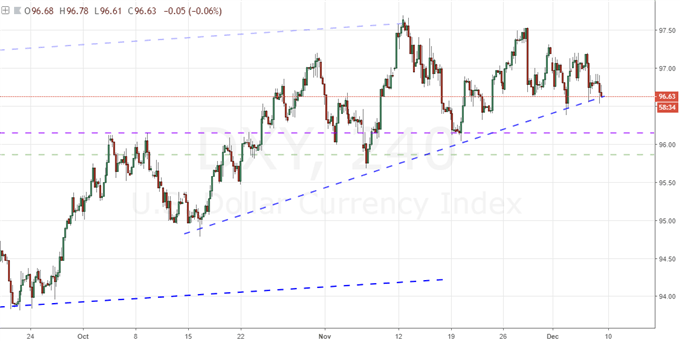
Chart DXY Dollar Index (4-Hour)

Dollar Wind Up Threatens to Resolve with a Break Before 2018 Ends

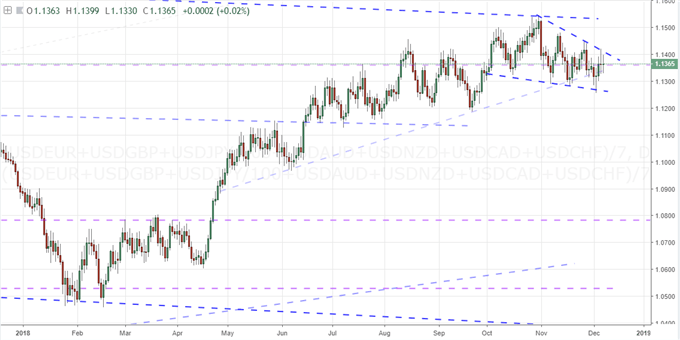
Looking to the trade-weighted Dollar index, the congestion is readily apparent. The swing high from early November – the highest level for this measure since June 2017 – is not far from where we end this past week. Theoretically, it would not take a significant charge to return the market to that level and possibly force a break. While 98 is a significant technical ceiling, it would likely be difficult to simply muster the level of appetite necessary to simply break short-term resistance and reach that figure – much less surpass it. The ‘path of least resistance’ in this case would be a break to the down side which could open up support established through the second half of the year down around 94. Such a move would still be difficult to build up to, but it still wouldn’t come with an inherent assumption of a full-blown trend.

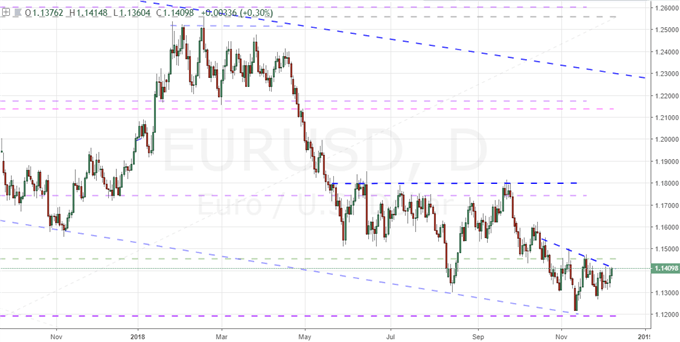
Chart EURUSD (Daily)

Dollar Wind Up Threatens to Resolve with a Break Before 2018 Ends

Looking into the major component of the DXY – EURUSD which accounts for approximately two-thirds of the measure – the picture is inverted but the same implications are apparent. There is a prevailing trend here (bearish or bullish for the Dollar), but the hesitation for progress is apparent. Price action over the past six weeks on this benchmark could readily qualify for an inverse head-and-shoulders pattern. Yet, the make up of the chart pattern alone means little. This classic pattern is used to qualify possible reversals, and there is a critical change in both tempo and direction that occurs under such circumstances. This is difficult to reconcile against the inevitable drained liquidity that we will be dealing with these coming weeks. That said, high volatility against a thin market can lead to more severe – if shorter-lived – moves.

Chart of Equally-Weighted Dollar Index (Daily)

Dollar Wind Up Threatens to Resolve with a Break Before 2018 Ends

With a look to an equally-weighted index, the general quality of the Dollar’s bearings do not change. Consolidation is even more apparent in this measure of the currency’s bearings while the technical lines are little more explicit. Consolidation is both common as pauses in prevailing trends as well as hesitation before reversal. The longer the indecision, the closer the conclusion’s outcome moves to a 50/50 chance. This is the longest period of reservation we have seen from the Greenback since it began its current bullish phase at the beginning of the year.

Chart of DXY Dollar Index and VXX Short-Term Volatility ETF (Daily)

Dollar Wind Up Threatens to Resolve with a Break Before 2018 Ends

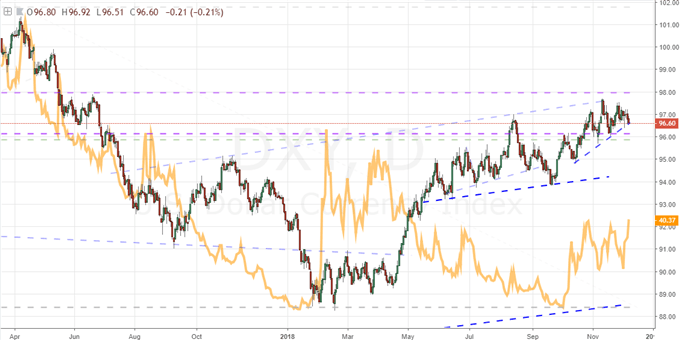
If you want to evaluate the potential for the Dollar in both direction of a break and follow through thereafter, there are few complementary charts that are worthy for frequent reference. The most pressurized catalyst for Dollar movement would be general market volatility. At different intensities of market activity, the Dollar will revert to different roles. If volatility is low or dropping rapidly, the currency would more likely see its carry trade appeal bolstered, but there may also be a moderate level of premium afforded to its safe haven status that would cool. Should risk aversion kick in a meaningful – though not severe – way, the currency is more likely to slide. Such a move would exploit the currency’s buoyancy through 2018 on the back of the carry trade premium that has built up. If, despite the anticipated fade in liquidity, markets explode and volatility surges, need for liquidity will revert the Dollar to its deep safe haven state and stoke a lasting bid. Above is the VXX ETF which measures short term volatility – and the market’s appetite to speculate on it…

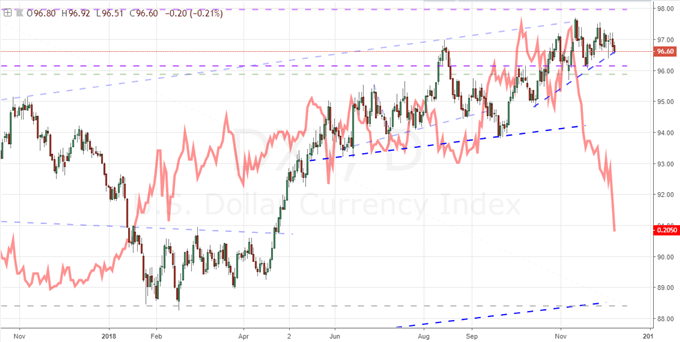
Chart of DXY Dollar Index and Implied Fed Funds Yield Curve Dec to Jan 2019 (Daily)

Dollar Wind Up Threatens to Resolve with a Break Before 2018 Ends

A rise or fall in volatility can establish different bearings for the Greenback, but to truly get a strong fix on its intent, you should consider that filter against another important measure – the anticipation of rates moving forward. Above is the expected Fed rate forecast via the curve through 2019. In other words, it looks at the forecasted rate Fed Funds rate in December versus January. Should it rise, that reflects anticipation of a steadily rising interest rate which is like a rising dividend for currencies. Should it drop – as it has this past month – it weighs on the perceived premium. Notably, the Dollar has held strong, but add some risk aversion to this equation, and it may be difficult to hold back the tide.

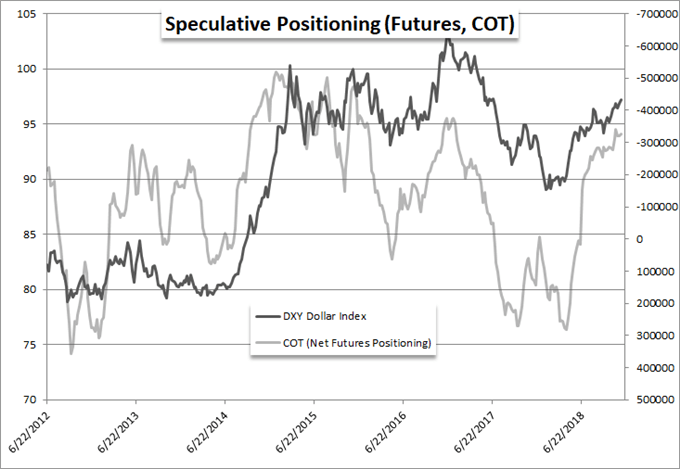
Chart of Net Speculative Positioning in Dollar Futures Contracts (Weekly)

Dollar Wind Up Threatens to Resolve with a Break Before 2018 Ends

The fuel to charge any fire – bullish or bearish – depends on the speculative depth the markets are able to muster. Liquidity is one aspect to that, but so too is the capacity for further build up of a net long position or conversely a deleveraging. Over the past few months, net speculative futures positioning behind Dollar contracts has struggled to make any significant progess following the dramatic reversal from the most bearish exposure in five years around the middle of the year. It is possible to warm bullish expectations, but to mount a dramatic appetite from the level of exposure this reflects is difficult to envision. Much easier to imagine is an abrupt reversal and the fleeing bullish exposure it would represent as the market deleverages.

Other Weekly Technical Forecast:

Australian Dollar Forecast – AUD/USD, AUD/JPY and EUR/AUD Trend Lines Broken

British Pound Forecast – Sterling Remains Weak


Source link


https://ift.tt/2QDp6au

Foundations of Technical Analysis: Seeing the Forest from the Trees


Identifying opportunities and how to use leverage effectively- a review of our technical approach and examples that illustrate our trading methodology in practice.


Source link


https://ift.tt/2SCC99q

vendredi 7 décembre 2018

GBPUSD Weekly Technical Outlook: Sterling Remains Weak


GBPUSD Technical Analysis

  • Triangle breakout on the four-hour chart nears.
  • Daily chart signals a re-test of the recent low.

We have recently released our Q4 Trading Forecasts for a wide range of Currencies and Commodities, including GBPUSD with our fundamental and medium-term term technical outlook.

GBPUSD – Short-term Breakout Nears

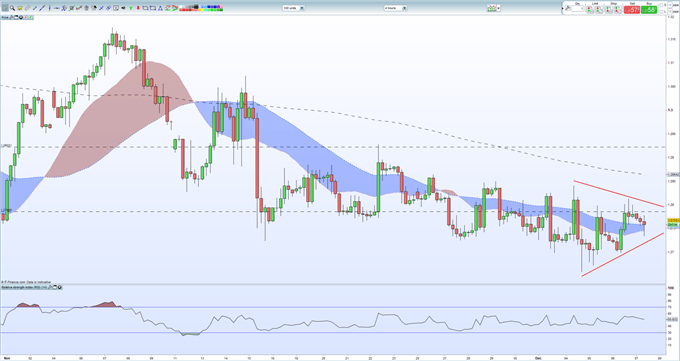
GBPUSD is currently rangebound and stuck within a triangle, pointing to a breakout in the short-term, and the downside looks more likely in the current environment. The pair are currently trading above the 20- and 50-day moving average, but any upside momentum is going to find resistance around 1.2800 – 1.2820. Sterling bulls may point to the recent higher lows being made as a sign of strength but a break below 1.2730 would negate this and leave the pair vulnerable to further falls with the recent multi-month low at 1.2658 the first target.

GBPUSD Four-Hour Price Chart December 7, 2018

GBPUSD Weekly Technical Outlook: Sterling Remains Weak

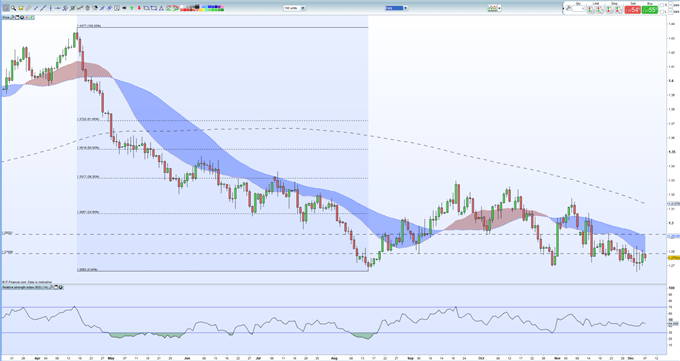
The daily GBPUSD chart paints a slightly different picture with lower highs dominating. The pair also trade below all three moving averages, with the 20 and 50-day mas providing resistance all the way back up to 1.2822. A break and close below the October 30 low at 1.2694 leaves 1.2658 vulnerable for a re-test.

GBPUSD Daily Price Chart December 7, 2018

GBPUSD Weekly Technical Outlook: Sterling Remains Weak

While the technical outlook may point to lower prices, the IG Retail Sentiment Indicator is suggesting that GBPUSD may move higher. Traders are 63.1% net-long GBPUSD – a bearish contrarian indicator – yet traders are less net-long than yesteday and compared with last week. This suggets that GBPUSD may move higher despite the fact that traders are net-long.

— Written by Nick Cawley, Analyst

To contact Nick, email him at nicholas.cawley@ig.com

Follow Nick on Twitter @nickcawley1

Other Weekly Technical Forecast:

Australian Dollar Forecast – AUD/USD, AUD/JPY and EUR/AUD Trend Lines Broken


Source link


https://ift.tt/2QlLQMw

Becoming a Better Trader – How to Create a Trading Plan


The importance of a trading plan can’t be overstated, but yet the number of traders who don’t have one far outnumbers those who do. Without a comprehensive plan of attack it is easy to get off course. Your plan doesn’t need to overly detailed, a couple of pages or so will do. There are a few key components which should be included, but keep in mind there is plenty of room for flexibility so as to tailor it to your needs. Keep this acronym in mind – K.I.S.S. (Keep It Simple Stupid) – as you go about constructing your trading plan.

Whether you are a new trader building a foundation or an experienced trader struggling (happens to the best), here are 4 ideas for Building Confidence in Trading

Must have a trading plan

In anything we set out to do, if we intend on it having a shot at success, don’t we plan ahead? Some type of plan? Then so it should be with trading. Markets are too dynamic, full of too much uncertainty, to try and navigate them without a framework in place. Trading plans are imperative for creating consistent results. They are also excellent for identifying strengths and weaknesses and then adjusting so you gravitate more towards what works and further away from what doesn’t.

What to include in your trading plan

Analytical approach

This is straight forward; what do you use to identify set-ups? It doesn’t matter so much what you use, just that it makes sense and is used consistently. It could be some combination of price support and resistance, trend-lines/slope analysis, chart patterns, Fibonacci levels, moving averages, Ichimoku Clouds, Elliot Wave Principle (EWP), sentiment, fundamentals, etc. Perhaps all together something else.

Favorite trade set-ups

What set-ups work best for you (get you excited)? It probably goes without saying, but these should be at the core of your trading. Set-ups are based on the alignment (confluence) of any number of factors which make for a high conviction trading opportunity. If you are new to trading, then this will take some time to figure out, so be patient in making progress towards understanding what works best for you.

A set-up is one thing, but how you execute it is another. We discussed this in detail in this 3-part series (Trading Breakouts | Trading Pullbacks | Combining Breakouts & Pullbacks). To recap one key point: There is the set-up, then the method by which you will take advantage of the set-up. For example, three traders could identify the same consolidation pattern; one will buy the breakout, another will wait for the first pullback after the breakout, and the third trader will do some combination of the two. Knowing how you best execute trades and what works for you is important.

What markets will you focus on?

Not every market moves the same, not everyone has the same interest in trading the same markets. Know which markets you focus on. It’s a good idea to keep your universe relatively small, helps keep things simple, and allows you to learn the personalities of the targeted markets and/or currencies. You can take it a step further and focus on specific time-frames for each market category. For example, you may trade equity indices on a very short-term time horizon (days or less), but choose to trade FX from a swing-trader standpoint (several days to several weeks). You could also have dynamic exposure to one market over another, i.e. – 75% FX, 25% indices/commodities.

Time-frame, hold time

What is the intended hold time for your trades, on average? Are you a swing-trader, holding for several days to weeks using weekly/daily/4-hr charts, or do you focus on day-trading, with hold times of a few hours or less, thus using daily down to even a 1-minute chart? It could be some blend of the two.

We understand the difficulties of trading, which is why we’ve put together a variety of guides designed to help traders of all experience levels.

Risk management

While we discussed this later in the webinar, the order is certainly not indicative of its importance. Without good risk management none of the rest of the trading plan will matter, at least not for long… You need to know your risk tolerance and adopt a risk management strategy which fits you. Know how much risk-per-trade you will take and total account risk across several positions. What is the max number of positions you will hold at once? (Fewer are easier to manage.)

Have a max drawdown figure in place as ‘kill switch’ when things aren’t going well. For example, if you experience a drawdown of 10% you will either take a break or at the least reduce your trading size. Remember, job #1 is capital preservation. (For more details, check out this webinar on risk management.)

Handling adversity (and success)

When you hit the inevitable drawdown, what will you do to make sure it doesn’t become damaging? You should reduce your trading size or stop trading altogether for a short period of time so you can alleviate stress and figure out what is going wrong. It is very important to have a plan for this before it happens.

It is also important to have a plan in place for when things are going well. Overconfidence can be a killer and lead to a drawdown if not correctly managed. While it is good to press it when market conditions are conducive and you’re doing well, but you need to do so responsibly. Increasing your risk by 50% isn’t out of control, but suddenly quadrupling it is, and will likely lead to a frustrating outcome.

Have a routine for staying on track

You should set aside time to reflect on the week’s events and how you traded. It’s a good idea to regularly review your trading plan and make tweaks if necessary. Periodical trade review and journaling are excellent ways to ensure you are following the process you have outlined in your plan, as well as identify patterns in your trading. Save charts of trade set-ups which stick out to you or you did well/poorly on for review later on.

Be rigid with your plan, but not too rigid. This can take some time for the newer trader to fully understand, but you want to have some flexibility in following your plan so as to not become too robotic. Unless you are trading with an algorithm, there is a ‘feel’ component to trading which should be incorporated. The more experienced you are the more this comes into play. The purpose of a plan and rules is to give you a strong foundation and boundaries to operate within…

For the full conversation, please see the video above…

Enjoy the video? Join Paul or any of the team’s analysts live each week for webinars covering analysis, fundamental events, and education.

Past recordings you might be interested in: Handling Drawdowns; Risk Management; Analysis, keeping it simple; 6 Mistakes Traders Make; Focusing on the Process; Building Consistency; Classic Chart Patterns, Part I;Classic Chart Patterns, Part II

—Written by Paul Robinson, Market Analyst

You can follow Paul on Twitter at @PaulRobinsonFX


Source link


https://ift.tt/2RDyrMI

Markets Crash to Fresh Yearly Lows


Bitcoin, Bitcoin Cash, Ethereum, Ripple: Prices, Charts and Analysis

  • Cryptocurrency market hits a fresh 2018 low and market cap may fall below $100 billion.
  • Bitcoin Cash (BCH) is in freefall.

Cryptocurrency Market Hammered Lower

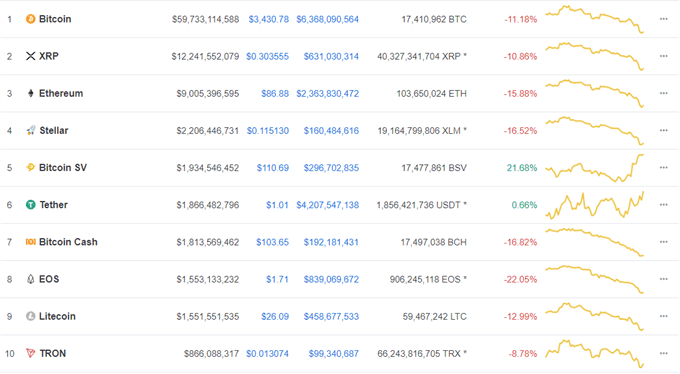
The cryptocurrency market as a whole made a fresh low for 2018 with its market cap falling to just over $108 billion, down from $835 billion at the start of the year. Turnover picked up as the market fell – a negative sign – while a lot of the charts have no solid support lines/areas left that are clear and qualifiable.

News that the SEC had once again delayed a decision on the VanEck bitcoin ETF until the end of February 2019 sent the market spinning lower. The SEC said that it is ‘appropriate to designate a longer period within which to issue an order approving or disapproving the proposed rule change so that it has sufficient time to consider this proposed rule change.’ The worry for the VanEck ETF is that continued market volatility will make it harder for the SEC to allow it to issue an ETF.

Many of the top 10 cryptos are suffering double-digit losses in the last 24 hours, taking out weak support levels along the way. Bitcoin (BTC) continues to trade towards support at just under $3,000, and if this breaks the July 16, 2017 swing low at $1,780 comes into play. Ethereum (ETH) currently trades around $84 and is now looking at the May 2017 swing-low at $62, while Litecoin (LTC) trades at $25 and may fall to the May 2017 low around $18. Bitcoin Cash (BCH) has probably been the largest fallers in the past few weeks, slumping from $634 to $100 in just one month.

Bitcoin, Ethereum, Ripple: Markets Crash to Fresh Yearly Lows

Investors remain net-long cryptocurrencies but recent changes give us a mixed trading bias – for example the number of traders net-short Bitcoin is up from last week. You can sign up to the IG Client Sentiment Indicator for free to get updated positioning data.

Cryptocurrency Trader Resources – Free Practice Trading Accounts, Guides, Sentiment Indicators and Webinars

If you are interested in trading Bitcoin, Bitcoin Cash, Ethereum, Litecoin or Ripple we can help you begin your journey. We have an Introduction to Bitcoin Trading Guide along with a Free Demo Account so you can practice trading this volatile asset class.

What’s your opinion on the latest cryptocurrency sell-off? Share your thoughts and ideas with us using the comments section at the end of the article or you can contact me on Twitter @nickcawley1 or via email at nicholas.cawley@ig.com.

— Written by Nick Cawley, Analyst.


Source link


https://ift.tt/2BXqRXV

WTI Holds Near $50/bbl; Bounce May Very Well Be Bull Trap


Technical Crude Oil Price Talking Points:

  • The ONE Thing: A bounce could very well be a trap for bulls. There is a lot of resistance near $56/bbl.-$59/bbl. that could bring back sellers.
  • Per IGCS, Crude sentiment favors a bounce, but long-term bias remains negative
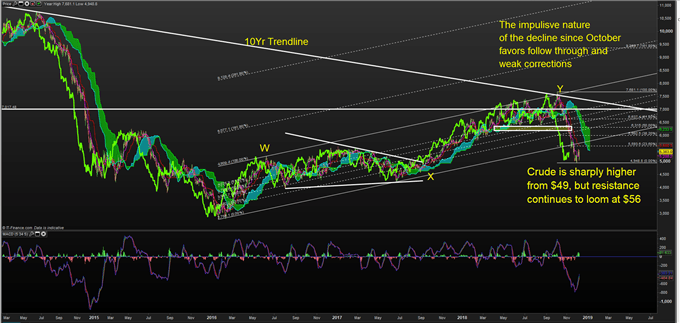
  • The Technical Picture: Selling rips appear to be preferred below the rising channel that was aggressively broken in this Q4 bear market in oil shown on the chart below. Crude is sharply higher from $49, but resistance continues to loom at $56New targets surface at $42-39, which becomes increasingly likely if US Dollar strength can continue.

Technical Forecast for <USOIL>: Bearish

WTI Holds Near $50/bbl; Bounce May Very Well Be Bull Trap

Data Source: Bloomberg

Technical traders soon learn that moves rarely happen in isolation. In Elliott Wave (learn more here) moves in the direction of the trend tend to take place in five ways, and counter-trend moves tend to happen in three waves.

Regardless of whether you think this is a new bear market or a bull market correction (the latter is getting harder to argue), there appears to be more selling to come. However, a bounce, albeit a small bounce relative to the decline, could be taking form post-OPEC+.

Looking at the chart above, the clear resistance for such a bounce to terminate utilizing Ichimoku as a guide would be $56/bbl. (the 26-day midpoint and Kijun sen) or into the cloud near the 38.2% retracement of the October-November decline near $59/bbl. The latter level is also well within the cloud, which tends to catch the first true retracement before trend continuation.

Bottom buyers will no doubt be encouraged by the ~5% rally on Friday, but resistance continues to loom large at $56/59 with a worsening global economic growth outlook that could cause the wind to blow in the bears favor soon.

Sentiment Favors A Bounce, But Long-Term Bias Remains Negative

WTI Holds Near $50/bbl; Bounce May Very Well Be Bull Trap

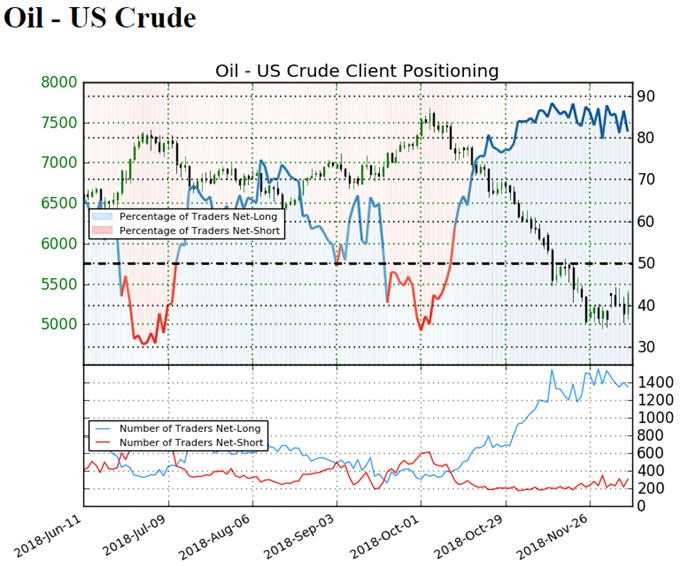
Oil – US Crude: Retail trader data shows 81.5% of traders are net-long with the ratio of traders long to short at 4.4 to 1.

In fact, traders have remained net-long since Oct 11 when Oil – US Crude traded near 7621.0; price has moved 29.5% lower since then. The number of traders net-long is 3.2% higher than yesterday and 7.2% lower from last week, while the number of traders net-short is 9.3% higher than yesterday and 6.1% lower from last week.

We typically take a contrarian view to crowd sentiment, and the fact traders are net-long suggests Oil – US Crude prices may continue to fall. Yet traders are less net-long than yesterday and compared with last week. Recent changes in sentiment warn that the current Oil – US Crude price trend may soon reverse higher despite the fact traders remain net-long (emphasis mine.)

—Written by Tyler Yell, CMT

Tyler Yell is a Chartered Market Technician. Tyler provides Technical analysis that is powered by fundamental factors on key markets as well as trading educational resources. Read more of Tyler’s Technical reports via his bio page.

Communicate with Tyler and have your shout below by posting in the comments area. Feel free to include your market views as well.

Checkout DailyFX’s New Podcast: Trading Global Market’s Decoded on iTunes

Talk markets on twitter @ForexYell

Other Weekly Technical Forecast:

Australian Dollar Forecast – AUD/USD, AUD/JPY and EUR/AUD Trend Lines Broken

British Pound Forecast – Sterling Remains Weak

US Dollar Forecast – Dollar Wind Up Threatens to Resolve with a Break Before 2018 Ends

Equity Forecast – Technical Forecast for the S&P 500, Dow Jones, DAX 30 & FTSE

Gold Forecast – Price Breakout Approaching Initial Targets


Source link


https://ift.tt/2BXXxjO

Successful Bear Market Trading Strategies & Techniques


Key Takeaways from the Trading Podcast:

  • How and when to adjust your position sizing when prices are volatile
  • Freeing up your margin by using less capital
  • Considering the opportunity cost of existing positions
  • Live to trade another day (absorb losses without blowing up your account)

Successful Bear Market Trading Strategies &amp; Techniques | Podcast

Adapting your approach in this trading environment is key to successful trading

In this week’s episode senior analyst, Tyler Yell, unpacks the recent spate of volatility in the markets and reveals how to tailor your approach to “Survive another day” should the move work against you.

Volatility has been cyclically depressed in recent years, appearing every so often but what we have seen in early 2018, and now toward the end of 2018, appears to be a pattern of volatility. So how should traders change their approach under such volatile conditions?

4 Bear Market Trading Strategies

Reduce position sizing

As volatility increases and price moves become more violent, reduce position sizes. Think of it this way, you can make twice as much money on half of the position in a bear market that exhibits 4 times its usual volatility. Reducing position sizes has the added benefit of keeping you calmer and help you to manage the emotions of trading.

Freeing up margin

An additional benefit stemming from lower position sizes is that you are left with more available margin. Put differently, you are using a lower proportion of your trading account which leaves ample room to take advantage of new trading opportunities. Typically, traders should have sufficient funds in the account to capitalise on volatility strategies such as, bear market rallies on short time frames and divergences that play out successfully.

Opportunity cost

This is probably one of the most overlooked bear market trading strategy as it is essentially a hidden cost. Regardless of the market, you’re looking for opportunities with an edge and in a fast-moving, volatile market, the positions that are losing tend to hold an opportunity cost that isn’t worth the potential profit.

By keeping an inventory of new opportunities, you’ll be less encouraged to keep losing trades and jump on new opportunities that volatility can take into the green quickly.

Live to trade another day

Keep the long-term in mind. The often-forgotten beauty of bear markets is that every day can present excellent opportunities for those that play both sides of the tape. While it may be exciting to trade large, one trade should never be so crucial that it can put you out of the game completely. James Stanley, who was recently interviewed on the show, sums it up perfectly when he says you should see each trade as Just One of a Thousand Insignificant, Little Trades.

Practical example of volatility seen in WTI Oil

Successful Bear Market Trading Strategies &amp; Techniques | Podcast

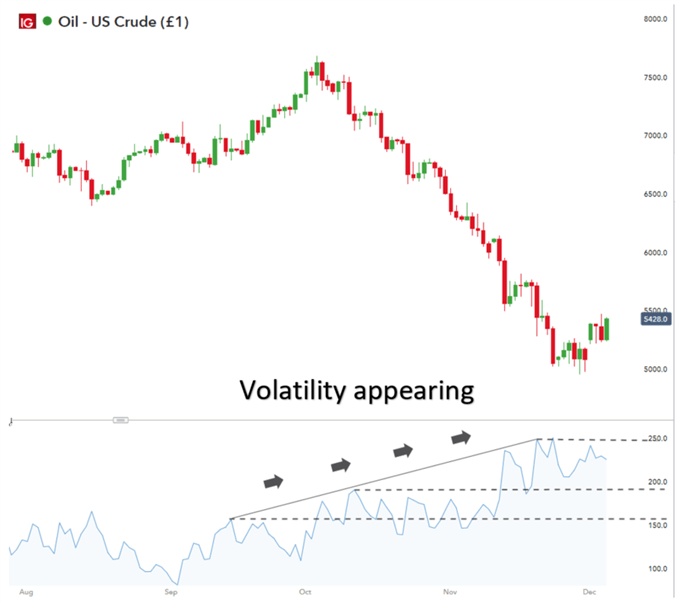
A helpful indicator that traders use to identify volatility is the Average True Range (ATR), which describes how much a market moves, on average, over a specified time(blue line).

Looking at the chart above, you will see that from August to September the ATR hovered around 160 points or less. The first sign of increased volatility surfaced around early to mid October and jumped even further in November. Traders should view the consistently higher volatility in October as a signal to reduce trading sizes. Reducing the trading size has the added benefit of freeing up margin for new trading opportunities. Such an opportunity appeared as WTI turned sharply lower.

The opportunity cost for long traders, in this example, is clear to see. Holding on to a long trade as the market moves lower and lower will increase your margin obligation and prevent you from taking advantage of new (more profitable) trading opportunities.

Adopting these strategies will increase the chances of you living to trade another day during turbulent markets.

Helpful resources:

  • If you are just starting out on your trading journey it is essential to understand the basics of Forex trading in our free New to Forex trading guide.
  • Jeremy Wagner, Head Forex Trading Instructor, provides a practical approach to trading volatile markets that all traders should be aware of.
  • If you are interested in a video example, Chief Currency Strategist, John Kicklighter, had produced an example on how to adopt a more Regimented Trading approach to volatile markets.
  • Upward trending markets don’t last forever which is why all traders should be able to identify and trade a bearish reversal.
  • Learn how to trade a bearish engulfing pattern.
  • At DailyFX we researched over 100,000 live IG Group accounts to find out the secrets of successful traders and published the findings in our Traits of Successful Traders.

If you found this article useful, you should follow our weekly podcasts. Whether you are looking for market analysis, trading education or interviews with well-known industry professionals, we have you covered.

Follow our podcasts on a platform that suits you:

iTunes:https://ift.tt/2L5G77R

Stitcher:https://ift.tt/2BXkZOh

Soundcloud:https://ift.tt/2L5G7Vp

Google Play:https://ift.tt/2BYjsaI


Source link


https://ift.tt/2L3SAcf

Oil Soars After OPEC+ Meeting Agree Production Cuts


Oil and OPEC+:

  • Brent crude touches $63/bbl. after production cuts revealed.
  • Brent nears a two-week high after heavy sell-off.

Q4 Trading Forecasts including Oil.

Oil Turns Sharply Higher on Production Cuts

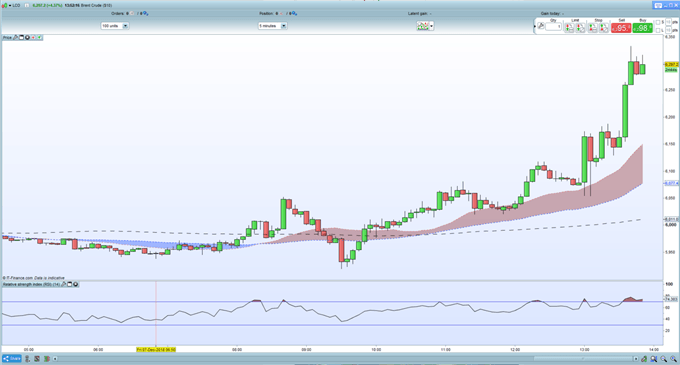
The latest OPEC+ meeting in Vienna agreed to remove 1.2 million barrels a day from the market, according to delegates on Friday. The announcement sent oil spinning higher with Brent trading back above $63/bbl. and nearing levels last seen two weeks ago. Brent crude recently entered a bear market after falling from a high price of $86.65/bbl. at the start of October to a low around $57.75/bbl. last week.

Oil Five-Minute Price Chart December 7, 2018

 Oil Soars After OPEC+ Meeting Agree Production Cuts

Retail traders are 86.2% net-long US Crude according to the latest IC Client Sentiment Data, a bearish contrarian indicator. However, recent changes in daily and weekly positions currently give us a stronger negative trading bias.

Traders may be interested in two of our trading guides – Traits of Successful Traders and Top Trading Lessons – while technical analysts are likely to be interested in our latest Elliott Wave Guide.

What is your view on Oil – bullish or bearish?? You can let us know via the form at the end of this piece or you can contact the author at nicholas.cawley@ig.comor via Twitter @nickcawley1.


Source link


https://ift.tt/2QmU4UX

Bitcoin Sentiment Sparks a Bullish Bias


IG Client Sentiment Chart

Net-Shorts Increase 238% Over The Past Week

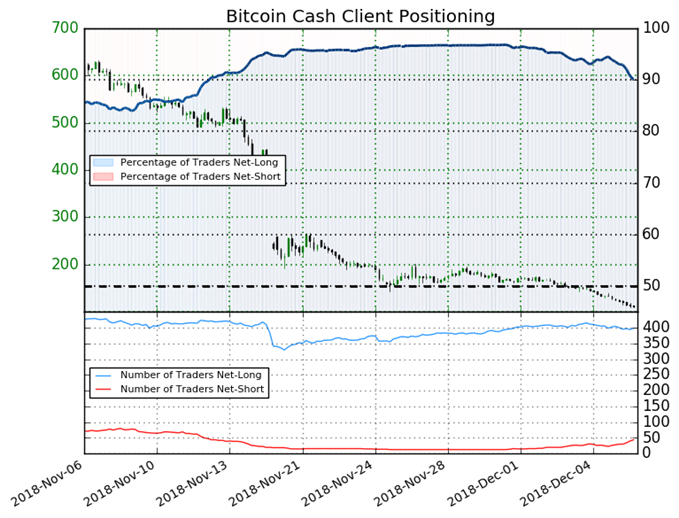
Bitcoin: Retail trader data shows 90.0% of traders are net-long with the ratio of traders long to short at 9.05 to 1. The percentage of traders net-long is now its lowest since Nov 10 when it traded near 547.51. The number of traders net-long is unchanged than yesterday and 4.5% higher from last week, while the number of traders net-short is 91.3% higher than yesterday and 238.5% higher from last week.

Be sure to check out our Bitcoin Trading Guide if you’re new to cryptocurrencies!

Bitcoin Sentiment Suggest Prices May Rise

We typically take a contrarian view to crowd sentiment, and the fact traders are net-long suggests Bitcoin prices may continue to fall. Yet traders are less net-long than yesterday and compared with last week. Recent changes in sentiment warn that the current Bitcoin price trend may soon reverse higher despite the fact traders remain net-long.

— Written by Fan Xu, DailyFX Research


Source link


https://ift.tt/2QgNCPc

Becoming a Better Trader – Fixing Mistakes, Working on Weaknesses


Small fixes can add up to big change

This may sound obvious, but this is an overlooked area of trader development – identifying weaknesses and turning them into strengths. It’s one of the reasons many trading mistakes are made over and over and over again. Even fixing the little stuff, making tweaks here and there can add to up to a big difference. Fixing a mistake in one area can help remedy a problem in another, and so on, it’s a process.

Whether you are a new trader building a foundation or an experienced trader struggling (happens to the best), here are 4 ideas to help you Build Confidence in Trading

It starts with keeping good records, journaling, and review

Without good records it is very difficult to pin-point problems let alone fix them. Going through your trade history can help you quickly see what you need to work on. For example, you can calculate risk/reward ratios, or see that you make money specific types of trades but lose on others.

In addition to looking at your trade history, a journal will help in identifying behavioral patterns which may need fixing. These are the hardest to remedy, but you can’t begin to address them if not brought fully into the light. The process of review should be done periodically, even if only once a week it can go a long way towards making progress.

We understand the difficulties of trading, which is why we’ve put together a variety of guides designed to help traders of all experience levels.

Take it slow and don’t overwhelm yourself

This will depend on your experience level, but you likely have several areas which need work. And that is OK. The key here is that you take it one step at a time and go slow. By trying to tackle all your issues at once you will become overwhelmed and frustrated.

Start with the most important. These are typically problems related to risk management. A topic we discuss weekly, for more check out this webinar dedicated to risk management. While talking about risk, another point to make is that some problems cross over into other facets of your trading, and so fixing one problem helps fix another.

For example, by trading within your personal risk tolerance you will avoid both larger drawdowns and find it easier to stick to predetermined stop losses and targets.

Be patient with your progress

There will be setbacks. Trader development is a process and can be a frustrating journey if not handled properly. So, don’t go hard on yourself if it takes longer than you like or think it should. Just be persistent and take it slow. If you find that along the way you start to slip and regress, take a step back, and, if needed, take a little time off to regain perspective.

It’s our competitive nature to want to push on through difficulties, but often times the best approach is to stop struggling and further tangling ourselves up in a mess. The problems and their solutions are more likely to appear when not trying too hard.

For the full conversation and examples, please see the video above…

Enjoy the video? Join Paul or any of the team’s analysts live each week for webinars covering analysis, fundamental events, and education.

Past webinars you might be interested in: Handling Drawdowns; Risk Management; Analysis, keeping it simple; 6 Mistakes Traders Make; Focusing on the Process; Building Consistency; Classic Chart Patterns, Part I; Classic Chart Patterns, Part II; Trading Breakouts; Trading Pullbacks; Combining Breakouts & Pullbacks

—Written by Paul Robinson, Market Analyst

You can follow Paul on Twitter at @PaulRobinsonFX


Source link


https://ift.tt/2RHFRyx

USD Drops as NFP Report Disappoints, However, Fed Outlook Unchanged


NFP Analysis and Talking Points

  • US Nonfarm Payrolls rose by 155k in November, missing expectations of 198k expected; Prior month revised Lower
  • US Average Hourly Earnings on the month falls short of consensus

See our latest Q4 FX forecast to learn what will drive the currency through the quarter.

NFP Report Review

US Bureau of Labor Statistics reported total nonfarm payroll (NFP) employment expanded by a 155k jobs in November, missing expectations of 198k. Alongside this, the headline figure for the prior month saw slight downward revision to 237k from 250k, resulting in a 2-month net revision of -12k. The unemployment rate remained at the lowest level since 1969 at 3.7%, which will continue to the delight of Fed officials given that they see NAIRU at 4.5%.

Wage Growth Holds Above 3%

The Fed focussed wage data rose in line with expectations for the yearly rate at 3.1%. However, monthly rate slightly disappointed expectations, rising 0.2%, short of the 0.3% expected, while the prior month saw a downward revision to 0.1%. Overall, despite the disappointment in today’s report, this does not change the outlook for the Fed. That said, the average gains in jobs for 2018 has been at 206k compared to 183k in 2017.

Market Response

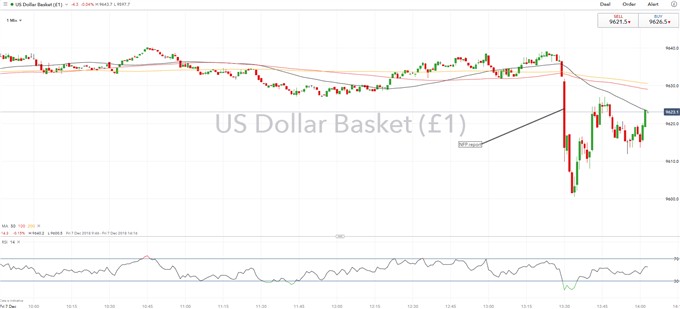
The soft jobs reports saw a weaker US Dollar upon release to pare its earlier advances with the DXY trading in the middle of its daily range. The move however was relatively minimal judging by historical standards, given that the report does not alter the Fed outlook a great deal.

DXY Price Chart 1: 1-minute time frame (Intra-day)

USD Drops as NFP Report Disappoints, However, Fed Outlook Unchanged

Chart by IG

— Written by Justin McQueen, Market Analyst

To contact Justin, email him at Justin.mcqueen@ig.com

Follow Justin on Twitter @JMcQueenFX


Source link


https://ift.tt/2QfQTOC

Volatility May Simmer Down After Springboard Bounce


S&P 500/Dow Jones Technical Highlights:

  • S&P 500 drops into support, has it on the move higher again
  • Dow Jones staved off further losses from confluent support
  • Volatility may die down a bit, but remain elevated

Traders are reacting to the uptick to volatility, to see how check out the IG Client Sentiment page.

S&P 500 drops into support has it on the move higher again

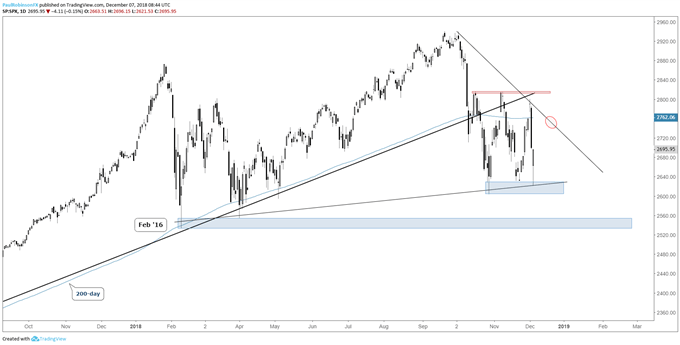
There is no shortage of volatility these days, making it a two-way market for nimble traders on the move. Yesterday’s fierce bounce came from trend-line support and near lows seen during this fall, and while the sharp drop and rebound has the market modestly tilted back higher, it won’t be long before a generally negative market tone is likely to stop a rebound in its tracks.

Given how high volatility is and the generally directionless nature of the market it’s a short-term traders market, any position held more than a couple of days is at risk of getting reversed. If the market is to continue to rebound it’s unlikely in the very immediate future we see a retest of yesterday’s lows, but as long as they hold then the bias is for a recovery back towards the trend-line off the record high and the area from around 2765 to 2800.

It will require a breakdown below the October low to spur another round of sustained selling into the yearly lows. While those levels and worse look to be in the works, we may see the market continue to work its way back-and-forth between levels and stave off a much sharper decline until the calendar flips to 2019. But as we have seen, just follow the market and the levels as volatility is pretty much rendering any outlook beyond a few days useless.

With global stocks falling sharply, see how this fits into our outlook for the remainder of the year in the Q4 Global Equities Forecast.

S&P 500 Daily Chart (High volatility between levels)

S&P 500 daily chart, high volatility between levels

Dow Jones staved off further losses at confluent support

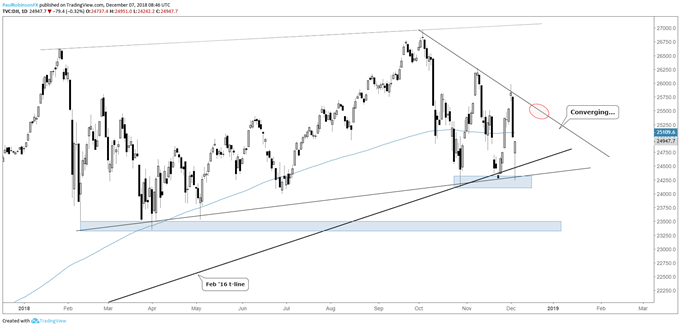
The bounce in the Dow came from confluent support via recent lows, a trend-line from earlier this year, and the February 2016 trend-line. It did pierce through these levels briefly, but the unstained selling makes it another successful hold. Looking for another bounce to develop up towards the trend-line off the record high which kept the upside limited to start the week.

The convergence between support and the trend-line off the high may be a reason to expect volatility to simmer down as we quickly draw near the end of the year, but the levels are far enough apart that volatility is expected to still remain high for short-term traders. If the convergence in price continues it could lead to an explosive move (likely lower) as we ring in a new year. A break below 24122 will have yearly lows and worse on the board.

Dow Daily Chart (Price converging above support)

Dow daily chart, price converging above support

To learn more about U.S. indices, check out “The Difference between Dow, Nasdaq, and S&P 500: Major Facts & Opportunities.” You can join me every Wednesday at 10 GMT for live analysis on equity indices and commodities, and for the remaining roster of live events, check out the webinar calendar.

Tools for Forex & CFD Traders

Whether you are a beginning or experienced trader, DailyFX has several resources available to help you; indicator for tracking trader sentiment, quarterly trading forecasts, analytical and educational webinars held daily, trading guides to help you improve trading performance, and one specifically for those who are new to forex.

—Written by Paul Robinson, Market Analyst

You can follow Paul on Twitter at @PaulRobinsonFX


Source link


https://ift.tt/2L387sW

A Complete Guide for Forex Traders


What are candlesticks in forex?

  • Forex candlesticks provide a range of information about currency price movements, helping to inform trading strategies
  • Trading forex using candlestick charts is a useful skill to have and can be applied to all markets

What could possibly be more important to a technical forex trader than price charts? Forex charts are defaulted with candlesticks which differ greatly from the more traditional bar chart and the more exotic renko charts. These forex candlestick charts help to inform an FX trader’s perception of price movements – and therefore shape opinions of trends, determine entries, and more.

All currency traders should be knowledgeable of forex candlesticks and what they indicate. After learning how to analyze forex candlesticks, traders often find they can identify many different types of price action far more efficiently, compared to using other charts. The added advantage of forex candlestick analysis is that the same method applies to candlestick charts for all financial markets.

Forex candlesticks explained

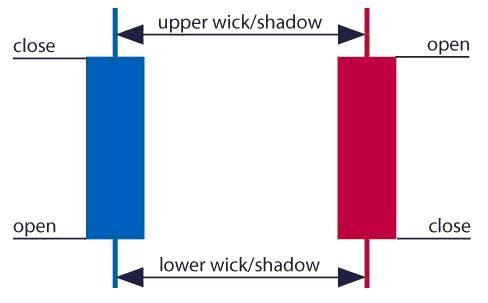
There are three specific points that create a candlestick, the open, the close, and the wicks. The candle will turn green/blue (the color depends on the chart settings) if the close price is above the open. The candle will turn red if the close price is below the open.

If you have the chart on a daily setting each candle represents one day, with the open price being the first price traded for the day and the close price being the last price traded for the day.

  • Open price: The open price depicts the first traded price during the formation of a new candle.
  • High price: The top of the upper wick. If there is no upper wick, then the high price is the open price of a bearish candle or the closing price of a bullish candle.
  • Low price: The bottom of the lower wick. If there is no lower wick, then the low price is the open price of a bullish candle or the closing price of a bearish candle.
  • Close price: The close price is the last price traded during the formation of the candle.

The image below shows a blue candle with a close price above the open and a red candle with the close below the open.

Forex Candlesticks: A Complete Guide for Forex Traders

See our page on How to Read a Candlestick Chart for a more in depth look at candlestick charts

Why forex traders tend to use candlestick charts rather than traditional charts

Candlestick charts are the most popular charts among forex traders because they are more visual. Candlestick charts highlight the open and the close of different time periods more distinctly than other charts, like the bar chart or line chart.

Candlestick charts have certain advantages:

  • Forex price movements are perceived more easily on candlestick charts compared to others.
  • It is easier to recognize price patterns and price action on candlestick charts.
  • Candlestick charts offer more information in terms of price (open, close, high and low) than line charts.

However, there are some disadvantages of candlestick charts:

  • Candles that close green or red may mislead amateur forex traders into thinking that the market will keep moving in the direction of the previous closing candle.
  • Candlestick charts may clutter a page because they are not a simple as line charts or bar charts.

How to trade forex using candlestick charts

Candlestick formations and price patterns are used by traders as entry and exit points in the market. Forex candlesticks individually form candle formations, like the hanging man, hammer, shooting star, and more. Forex candlestick charts also form various price patterns like triangles, wedges, and head and shoulders patterns.

While these patterns and candle formations are prevalent throughout forex charts they also work with other markets, like equities (stocks) and cryptocurrencies.

Trading forex using candle formations:

The hanging man:

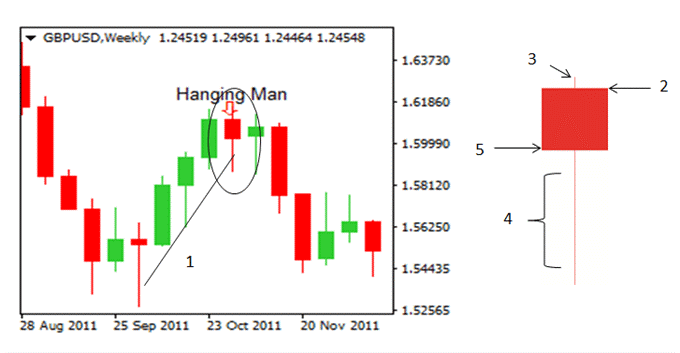
The hanging man candle, is a candlestick formation that reveals a sharp increase in selling pressure at the height of an uptrend. It is characterized by a long lower wick, a short upper wick, a small body and a close below the open.

It is a bearish signal that the market is going to continue in a downward trend. Learning to recognize the hanging man candle and other candle formations is a good way to learn some of the entry and exit signals that are prominent when using candlestick charts.

The chart below shows the GBP/USD on a weekly timeframe. This means that each candle depicts the open price, closing price, high and low of a single week. The hanging man candle below (circled) is a bearish signal. Traders use bearish signals like this to enter short trades, a bet on the GBP depreciating relative to the USD.

If a trader uses the hanging man to execute a short trade, he/she should then place a stop loss and a take profit with a positive risk-reward ratio.

Forex Candlesticks: A Complete Guide for Forex Traders

The Shooting Star

A shooting star candle formation, like the hang man, is a bearish reversal candle that consists of a wick that is at least half of the candle length. The long wick shows that the sellers are outweighing the buyers. A shooting star would be an example of a short entry into the market, or a long exit.

Traders could take advantage of the shooting star candle by executing a short trade after the shooting star candle has closed. Traders could then place a stop loss above the shooting star candle and target a previous support level or a price that ensures a positive risk-reward ratio. A positive risk-reward ratio has been shown to be a trait of successful traders.

Forex Candlesticks: A Complete Guide for Forex Traders

The Hammer

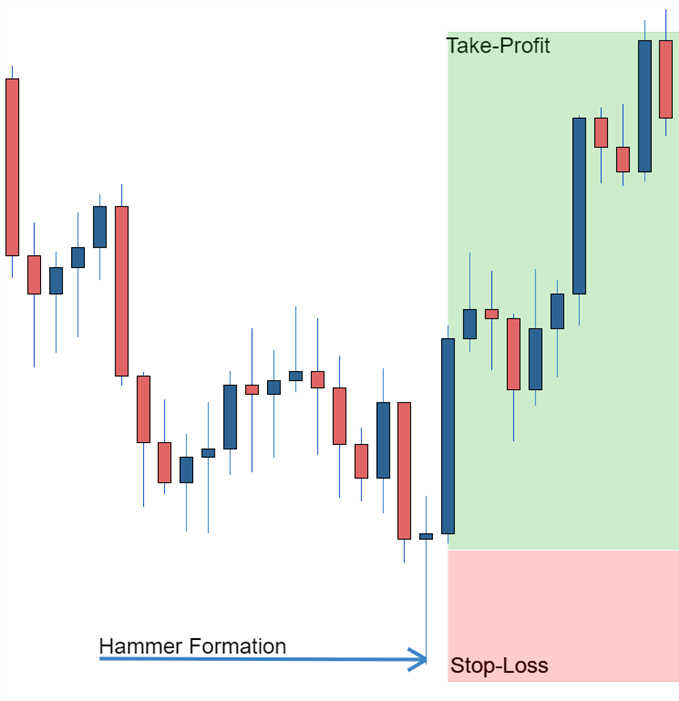
The hammer candle formation is essentially the shootings stars opposite. It is a bullish reversal candle that signals that the bulls are starting to outweigh the bears. It is characterized by its long wick and small body. A hammer would be used by traders as a long entry into the market or a short exit.

The image below is an example of how a forex trader would use the hammer candle formation to enter a long trade, while placing a stop-loss below the hammer candle and a take profit at a high enough level to ensure a positive risk-reward ratio.

Forex Candlesticks: A Complete Guide for Forex Traders

Take your forex trading to the next level

Supplement your understanding of forex candlesticks with one of our free forex trading guides. Our experts have also put together a range of trading forecasts which cover major currencies, oil, gold and even equities.


Source link


https://ift.tt/2BVYjxI

Consumer Confidence Remains Stable but Future Expectations Wane


Talking Points:

  • The index of current conditions jumped 2.9 points to 115.2 from 112.3 in November
  • Consumer expectations dipped which could suggest lower confidence in current conditions in coming reports
  • Respondents noted hearing more negative news about job prospects as non-farm payrolls disappoint

Current Conditions Remain Strong

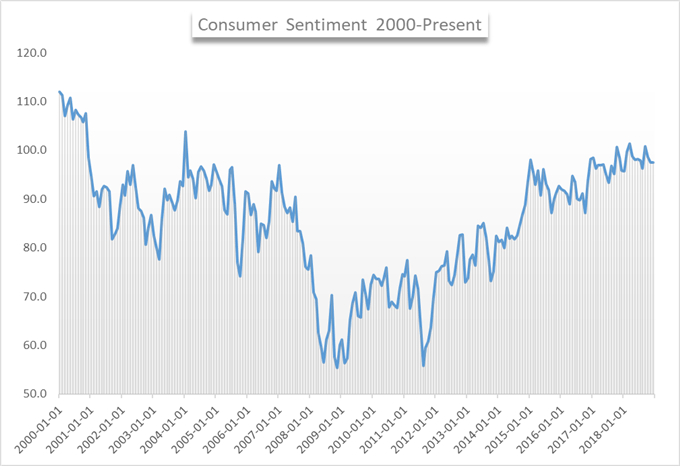
The monthly survey of consumers from the University of Michigan was released Friday morning to reveal no-change from November for consumer sentiment. The index read 97.5 and equals the average from January 2017 to December 2018. According to Richard Curtin, the survey’s curator, the last time the sentiment index was consistently above 90 for at least this long was from 1997 to 2000. During that time, the four-year average was 105.3.

university of michigan consumer sentiment december

Learn to trade around news events and data releases with our Introduction to Forex News Trading guide.

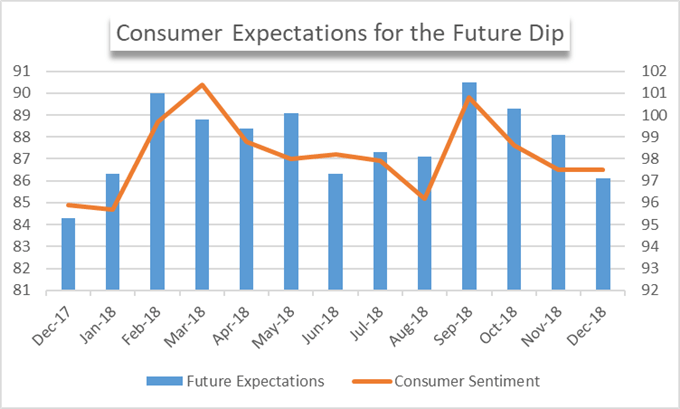
Respondents also saw strength in current economic conditions. Despite an equity market tumble and rising costs from the US-China trade war, the current conditions index rose to 115.2 from 112.3 in November. Conversely, future expectations read slightly lower.

university of michigan future expectations december

The index of consumer expectations was the sole area of December’s report that read lower. While it suffered a slight decline, the change from 88.1 to 86.1 is well within the acceptable range and was easily offset by the uptick in current conditions.

That said, the index has declined for four months straight and various factors have been to blame. In previous declines, rising interest rates were cited as consumers voiced concern over higher borrowing costs. This month, the headline concerns were job prospects for the future.

Non-Farm Payrolls Fall Short

The concern was verified from a hard data perspective after a disappointing non-farm payroll release also on Friday. Still, the unemployment rate remained at a multi-year record 3.7%. With the list of concerns for the future growing, future reports may begin to see a slight dip in consumer sentiment. As a leading indicator, a dip in confidence would bolster the argument of many speculators that assert global growth is slowing. But currently, consumers remain confident and the holiday season offers an opportunity for increased consumer expenditure.

–Written by Peter Hanks, Junior Analyst for DailyFX.com

Contact and follow Peter on Twitter @PeterHanksFX

Read more: S&P 500 Plunges, DAX Enters Bear Market on Trade War Fears

DailyFX forecasts on a variety of currencies such as the US Dollar or the Euro are available from the DailyFX Trading Guides page. If you’re looking to improve your trading approach, check out Traits of Successful Traders. And if you’re looking for an introductory primer to the Forex market, check out our New to FX Guide.


Source link


https://ift.tt/2UqUckp